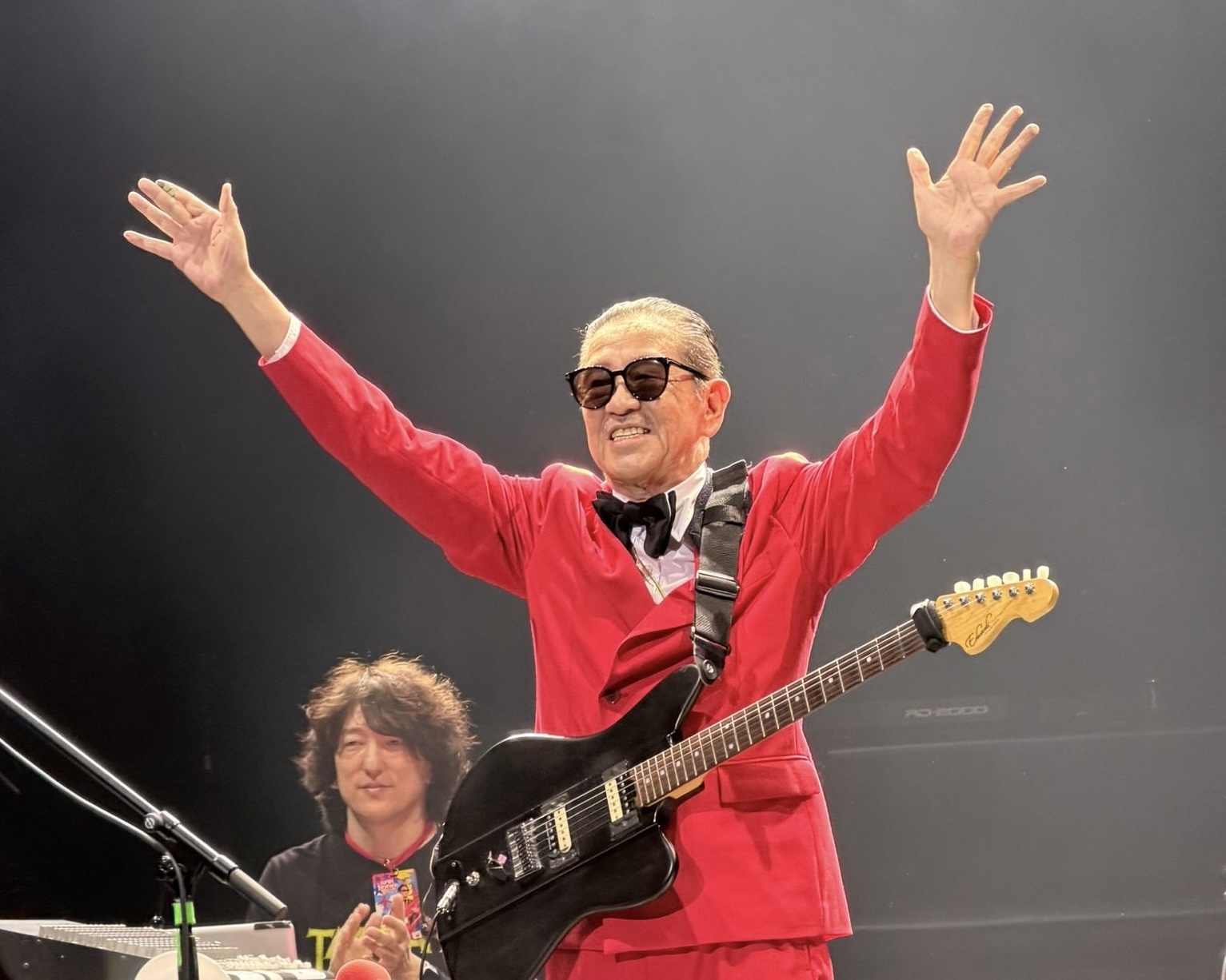


This is not a teenage boy band, it is not a chart-topping pop singer, and it is not a DJ whose mixes haunt the clubs of the city’s hippest neighborhoods. It is 73-year-old jazz fusion guitarist Masayoshi Takanaka, kicking off the first world tour of his 50+ year career.
Even more perplexing is the demographic of the crowd. For a legacy act like Takanaka, the audience is seemingly exclusively young millennials and zoomers. They can “bah dah bah” along to every melody and seem to be prepared for every act of fanfare that the guitarist and his backing band have up their sleeve, like the appearance of his signature surfboard guitar during the encore. This is not your parent’s (or your grandparent’s) kind of comeback tour. This is a renaissance for a previously obscure artist, finding a new audience and a new lease on his career.
New mediums for music exploration bring fans in droves, as the guitar hero is learning on his current tour across Europe and North America. The younger audience gravitates to the vibe his music represents as much as the music itself. Austin Counihan, a fan who attended Takanaka’s Brixton show April 1st told Brut. “I think it spread like wildfire because, for the most part, there are very few lyrics in his songs and they all sound happy and put you in a good mood.”
While a younger audience may come with their own value sets and prejudices shaped by a music landscape completely different from that of the 70s and 80s, that change of approach can lift certain barriers on how the audience perceives an artist. Counihan added, “I don’t speak Japanese but I know a good guitar riff when I hear one.”
Artists who are coming up in the current moment might find themselves under more ridicule by their potential audience because their image is being shaped in the moment. But when music lovers discover a guitar legend that has been doing his things for decades, they seem more open to take him as he is.
This process may be most visible in the virality of a video Takanaka made over 20 years ago–a medley of songs which he plays above and within crystal clear water. The serenity he exudes in the portion where he plays his second-most-streamed song “Oh! Tengo Suerte” has captured the imagination of TikTokers and Instagram Reelers alike. Other video memes recreate the quirky poses and captivating backdrops of his album covers.
The novelty of this career renaissance is not lost on Takanaka himself. He recently told The Guardian: “I was actually planning to fade out [my career],” he says on a video call. “But now I feel like this might be my second coming. My life has changed so much in the last few years.”
This phenomenon is not new to the concert stage and the album charts. The popularization of music streaming apps in the past 20 years has already opened the door to exploration. You no longer need to visit a dingy record shop in your town, operated by a curmudgeon with an encyclopedic knowledge of the medium (and maybe a few too many stuffy opinions) to impart on you and broaden your horizons. The iPhone, the shuffle button, and the algorithm can do a decent job of that for you.
Another factor in this evolution of the industry is the way in which social media/entertainment apps like TikTok allow users to add music to their posts. This has had the effect of turning previously forgotten songs into the signature output in a band’s discography for a new generation’s zeitgeist, as with the band Pavement and their song “Harness Your Hopes.”
The wordy stream-of-consciousness b-side, once dropped from an album and relegated to an LP, is now their most-streamed song on Spotify, with 200 million more plays than their second most popular song on the app. For NME in 2022, Guitarist Scott Kannberg remarked that the song’s resurgence “It breathed new life into Pavement, really.” Frontman Stephen Malkmus added “It made me feel bad that I didn’t put it on the album. Like, nobody said, ‘That’s a great song’ or something.”
Artists do still break and make comebacks the old-fashioned way, through appearances in TV shows and films. But the virality of these songs increases exponentially when it breaks containment and becomes a trend on TikTok or Instagram Reels. Kate Bush is in the midst of a second-second wind thanks to the release of Emerald Fennel’s adaptation of Wuthering Heights and the British singer’s debut single of the same name. Although Bush’s ballad is not featured in the film, it was a short walk for movie-goers to reach her song upon exiting the theater or viewing the trailer. The single re-entered the UK singles charts, reaching number 49, but once again it was truly felt on social media. Whether you are documenting van life in a stunning drone flight, or giving your wedding photographer a round of applause for their work, these songs have been plugged into the unconscious rolodex of songs we live our lives to.
While Kate Bush, a Grammy-nominated and chart-topping solo act, did not need much help from social media to preserve her legacy. It generated new waves of enthusiasm for artists who were on an extended hiatus or soft-launching retirement. Whether they choose to ride that wave into a sold-out world tour, or simply pat themselves on the back, will vary depending on their relationship to their own success.
Pavement appear to be content with their status as the underground old guard. Their most public act as a band this century consisted of an underseen experimental biopic and a smattering of reunion shows. Takanaka is touring at a scale and breadth previously unimaginable. Kate Bush has remained largely out of the spotlight, even declining to attend her own induction into the Rock & Roll Hall of Fame.
One thing that seems to be out of the musician’s hands entirely is the predictability and the degree to which they go viral to find a new generation of listeners.